
The AI Economy Has Redefined Business. the Question Is No Longer Whether You Need a Website, but Whether Your Business Can Survive Without One.
South Africa has entered a new era of commerce where consumers no longer discover businesses the way they did a decade ago. Search engines, AI assistants, online reviews, digital maps, and websites have become the first point of contact between businesses and customers. While many entrepreneurs continue to rely solely on social media pages or messaging applications, research shows this approach exposes businesses to unnecessary risk, limits discoverability, and weakens customer trust. This editorial investigation examines the changing digital landscape, the rapid growth of artificial intelligence, consumer behaviour, online credibility, and the economic reality facing South African businesses. It also explores why owning a professional website has become one of the most important business assets in the modern economy.
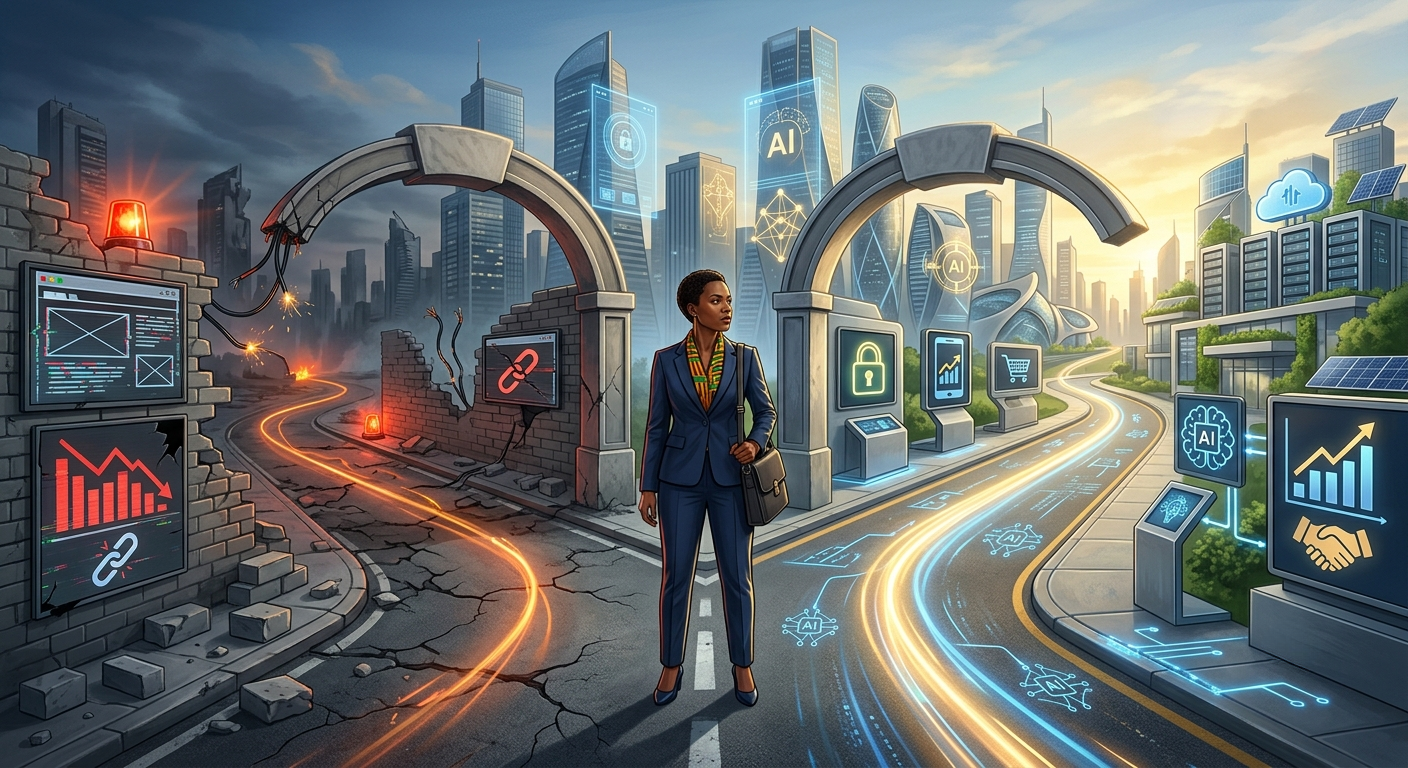
Why South African Businesses Are Losing Customers Before the First Conversation Even Begins
The Digital Economy Has Quietly Changed the Rules
Many South African business owners still believe that having a Facebook page or a WhatsApp Business profile means they have an online presence.
Technically they do.
Strategically they do not.
The internet has undergone one of the biggest transformations since smartphones became mainstream. Businesses are no longer competing only against local competitors. They are competing for visibility inside Google Search, Google Maps, Bing, ChatGPT, Gemini, Copilot, Perplexity, and dozens of AI-powered search experiences that increasingly determine which businesses consumers discover first.
In other words, the first impression is no longer your shopfront.
It is your digital footprint.
Research indicates South Africa has approximately 51.7 million active internet users, representing an internet penetration rate approaching 80 percent. South Africans also spend among the highest amounts of time online globally, averaging more than nine hours every day across devices.
Those numbers tell an important story.
Consumers are already online.
The only question is whether your business is visible when they begin searching.
AI Is Not Replacing Businesses. It Is Replacing Invisible Businesses.
Artificial intelligence has fundamentally changed how information is discovered.
Instead of scrolling endlessly through social media, consumers increasingly ask AI assistants questions such as:
"Who designs ecommerce websites in South Africa?"
"Best printing company near me."
"Affordable digital marketing agency."
"Website designers for small businesses."
AI systems cannot recommend businesses they cannot properly understand.
This creates a significant challenge for businesses operating only through Facebook pages.
Unlike websites, social media pages contain limited structured information, little searchable content, minimal technical optimisation, and restricted ownership.
Professional websites provide AI with far richer information.
Services.
Pricing.
Locations.
Frequently asked questions.
Case studies.
Articles.
Customer testimonials.
Business information.
Technical metadata.
This allows AI systems and search engines to better understand what a business actually does.
The businesses investing in websites today are effectively training tomorrow's search engines to recognise their expertise.
Those waiting may find themselves absent from the conversations that matter most.
Trust Is the New Currency
South Africa has experienced a dramatic increase in online scams, cloned social media accounts, phishing attacks and fraudulent online businesses.
Consumers have adapted accordingly.
They verify.
They compare.
They investigate.
Studies consistently show that approximately 75 percent of consumers judge a company's credibility based primarily on its website.
This should not surprise anyone.
A professionally maintained website demonstrates commitment.
It signals permanence.
It shows transparency.
It gives customers somewhere they can independently verify information rather than relying solely on social media posts.
Imagine two companies.
Both sell identical products.
The first has only a Facebook page.
The second has:
A professional website.
An About page.
Terms and Conditions.
Privacy Policy.
Contact information.
Google Maps integration.
Customer reviews.
Product pages.
Articles demonstrating expertise.
Which business appears more trustworthy?
Most consumers answer that question in seconds.
That decision often determines where their money goes.
Renting Versus Owning Your Digital Property
One of the biggest misconceptions in digital marketing is that social media replaces a website.
It does not.
Social media is rented space.
A website is owned property.
This distinction matters far more than many entrepreneurs realise.
Facebook can suspend your account.
Instagram can reduce your reach.
TikTok can change its algorithm.
WhatsApp conversations can disappear.
Followers do not belong to you.
The platform owns the audience.
Your website, however, belongs to your business.
You control the domain.
You control the content.
You decide how customers experience your brand.
No algorithm determines whether your customer can find your pricing page.
No platform decides whether your enquiry form is visible.
No social media update can suddenly erase years of investment.
Owning a website is comparable to owning commercial property instead of renting a market stall.
Both have value.
Only one creates long-term business equity.
Why Search Engines Still Matter
Social media creates attention.
Search engines capture intent.
There is an enormous difference.
A person scrolling Facebook may eventually notice your advertisement.
A person searching Google for "website designer in Gauteng" is already looking to buy.
That customer has entered the decision stage.
Research consistently estimates that around 46 percent of Google searches have local intent.
Consumers search for businesses close to them every minute.
Electricians.
Restaurants.
Printers.
Lawyers.
Mechanics.
Marketing agencies.
Medical practices.
If your business has no searchable website, you are effectively invisible during one of the most valuable moments in the buying journey.
That is not simply a marketing problem.
It becomes a revenue problem.
The Mobile First Reality
South Africa's digital economy is overwhelmingly mobile.
More than three quarters of internet users access online services primarily through smartphones.
For many consumers, their phone is their only computer.
This means websites are no longer designed for desktop users first.
They must be designed for mobile experiences.
Fast loading.
Simple navigation.
Readable text.
Optimised images.
Secure checkout.
Easy contact options.
Businesses investing in mobile-first websites position themselves where their customers already are.
Businesses ignoring mobile optimisation create friction that pushes customers elsewhere.
The E Commerce Opportunity
South Africa's ecommerce sector continues to expand rapidly.
Online shopping is no longer limited to major metropolitan areas.
Courier networks have improved.
Payment gateways have matured.
Consumers have become comfortable purchasing online.
Smartphones now account for the majority of online transactions.
For small businesses this represents an unprecedented opportunity.
A website allows customers to browse products outside business hours.
Place orders automatically.
Pay securely online.
Request quotations.
Book appointments.
Download information.
Contact staff instantly.
Your website effectively becomes a permanent employee working every hour of every day.
Unlike traditional staff, it does not close for weekends, public holidays or annual leave.
It simply continues serving customers.
Bubble Bekkie Advertising's Perspective
Working with South African businesses across multiple industries has highlighted a recurring pattern.
Many business owners invest significant time and money creating social media content while overlooking the one digital asset they actually own.
The result is predictable.
Businesses generate short bursts of visibility but struggle to build long-term authority in search engines.
A website changes that equation.
When supported by quality content, technical SEO, fast hosting, secure infrastructure, and consistent optimisation, it becomes more than a marketing tool.
It becomes the central foundation of the business's digital presence.
That philosophy has shaped Bubble Bekkie Advertising's approach to website design and digital marketing.
Rather than viewing websites as online brochures, the focus is on building platforms that educate, convert visitors into customers, and provide lasting value through search visibility and user experience.
The objective is not simply to create attractive websites.
It is to create digital assets capable of growing alongside the businesses they represent.
Conclusion
Artificial intelligence has not made websites less important.
It has made them indispensable.
As search evolves beyond keywords into intelligent conversations, businesses need digital foundations that AI can understand, consumers can trust, and search engines can confidently recommend.
South Africa's digital economy is moving quickly.
The businesses that invest in owning their digital presence today will be better positioned for tomorrow's search landscape.
The question is no longer whether a website is affordable.
The more important question is whether remaining invisible has become the greater cost.
Contact the Author
Want to reach out to the author?
Login to contact author