
Binghatti Is Building a New Dubai Address for the World. Should South Africans Be Paying Attention?
Binghatti is emerging as one of Dubai’s most notable property developers, combining rapid financial growth with distinctive architecture and branded residences developed alongside Mercedes-Benz, Bugatti and Jacob & Co. With more than 12,500 residential units delivered, over 80 projects and billions of dirhams in development, the company is becoming increasingly relevant to international property investors.
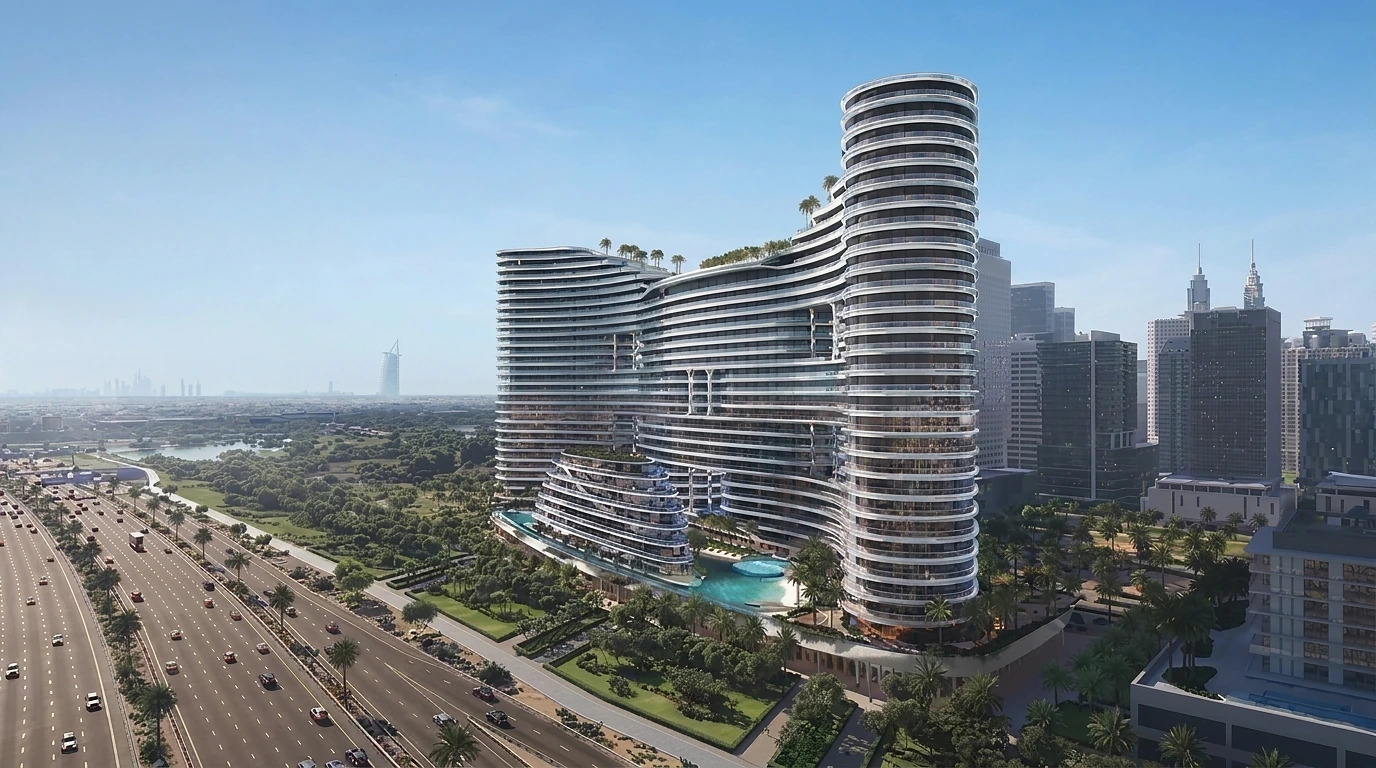
JOHANNESBURG / DUBAI — There are more than 11,000 kilometres between Johannesburg and Dubai, but for a growing class of South African entrepreneurs, executives and internationally mobile families, the distance between the two cities is becoming increasingly irrelevant. Dubai has evolved from a favourite stopover and holiday destination into a serious consideration for international business, residency, wealth diversification and property ownership. The more important question is no longer whether South Africans are looking at Dubai, but what they should be looking at when they get there.
One name increasingly difficult to overlook is Binghatti.
The Dubai property developer recorded AED12.43 billion in revenue in 2025, AED3.58 billion in net profit and more than 17,000 unit sales during the year, while its portfolio of completed, ongoing and pipeline developments approached AED100 billion. Those figures alone would make Binghatti worth watching. But numbers only explain part of what the company is doing.
Binghatti has managed to place itself at an unusual intersection between property development and some of the world's most recognisable luxury brands. It is the developer behind the world's first Bugatti-branded residential development, has created residences with Jacob & Co, and is developing its relationship with Mercedes-Benz from an individual residential tower into what has been announced as the world's first Mercedes-Benz-branded city.
For the South African investor, that deserves more than a passing glance.
Not because a Mercedes-Benz badge automatically makes an apartment a good investment, and certainly not because a Bugatti name removes the need for due diligence. It matters because the company behind these developments is attempting something considerably more ambitious: turning the identity normally associated with a car, watch or luxury house into something that can belong to an address.
And it is doing so in one of the world's most active property markets.
Dubai Has Plenty of Developers. So Why Binghatti?
Anyone who has spent even a few hours driving through Dubai could reasonably ask whether the city really needs another property developer. The cranes suggest otherwise.
What makes Binghatti interesting is not simply the number of buildings carrying its name, but the philosophy behind them. Founded in 2008 by Dr Hussain BinGhatti, the company has developed an architectural language intended to make its buildings identifiable rather than anonymous additions to Dubai's skyline.
Today, Binghatti says it has delivered more than 12,500 residential units, with a portfolio exceeding 80 projects valued at more than AED80 billion, spanning areas including Downtown Dubai, Business Bay, Meydan, Jumeirah Village Circle, Jumeirah Village Triangle, Al Jaddaf and Dubai Silicon Oasis. There is considerable commercial weight behind the architecture.
For 2025, Binghatti reported revenue of AED12.43 billion and net profit of AED3.58 billion. Its momentum has continued into 2026, with the company reporting a substantial contracted development and sales backlog. Capital markets have noticed too.
In February 2026, Binghatti priced a US$500 million five-year sukuk that attracted an order book peaking at approximately US$2.46 billion, making the transaction more than 4.4 times oversubscribed. International investors accounted for 51% of the order book.
For a prospective property buyer, these numbers do not guarantee the performance of an individual apartment. What they do provide is something equally important when assessing a developer: context.
Then Binghatti Put Bugatti on the Front Door
There are luxury apartments, and then there are apartments where your car can apparently come upstairs with you.
Bugatti Residences by Binghatti, located in Dubai's Business Bay, is the world's first Bugatti-branded residential development. Its Sky Mansion residences include private car lifts allowing owners to bring their vehicles directly into their homes. Suddenly, underground parking sounds rather ordinary.
The development contains 182 individual residences, and the market has already produced some extraordinary transactions.
Brazilian football star Neymar Jr. acquired an AED200 million Sky Mansion in the development. Opera icon Andrea Bocelli has also purchased a residence there.
More significantly for the property market, Binghatti reported that Bugatti Residences achieved a record transaction of US$150 million, establishing a new Business Bay benchmark of AED11,650 per square foot.
Current residences listed directly by Binghatti illustrate just how wide the upper end of this market can become: two-bedroom Bugatti Residences start at approximately AED19.5 million, three-bedroom residences from AED29.4 million, while certain four-bedroom residences are listed from AED165 million. This is clearly not mass-market Dubai property.
But it demonstrates what Binghatti is attempting at the very top of its portfolio.
Mercedes-Benz Changes the Conversation
Mercedes-Benz takes the proposition in another direction. The relationship initially produced Mercedes-Benz Places | Binghatti in Downtown Dubai, translating the design philosophy associated with the German automotive company into residential architecture.
In January 2026, the partnership expanded considerably with the launch of Mercedes-Benz Places | Binghatti City, a major development in Dubai's Meydan area described by the companies as the world's first Mercedes-Benz-branded city. And this is where the story becomes more relevant to a broader group of international buyers.
Binghatti currently lists residences within Mercedes-Benz Places | Binghatti City from approximately AED1.6 million, depending on configuration and availability.
That places entry into a globally branded Binghatti development at a very different level from the AED19.5 million starting point of Bugatti Residences. It also illustrates something important about the company.
Binghatti is not operating exclusively at one end of the market. Its wider portfolio includes premium and more accessible residential developments alongside ultra-luxury branded properties.
For South Africans researching Dubai property investment, that distinction matters.
So Why Are We Talking About Dubai Property in Johannesburg?
Because Dubai's property market is no longer something that can be dismissed as an international curiosity.
According to the Dubai Land Department, the emirate recorded 226,000 real estate transactions worth AED761 billion in 2024, representing year-on-year growth of 36% in transaction volume and 20% in value. And the market has continued moving.
During the first quarter of 2026 alone, Dubai recorded AED252 billion in real estate transactions, an increase of 31% in value compared with the same period a year earlier. Property investments during the quarter reached AED173 billion across 57,744 transactions. Those are substantial numbers by any measure.
For South African entrepreneurs, executives and private investors already considering international diversification, Dubai therefore deserves to be understood as a market rather than admired merely as a destination.
Its geographic position between Africa, Europe and Asia, established aviation links, international business environment and increasingly global population have created a property ecosystem attracting buyers from numerous jurisdictions. That does not automatically make Dubai property a good investment. It makes it a market worth investigating properly.
What Can a South African Actually Buy?
This is where the glossy Dubai skyline needs to meet a calculator. At the top of Binghatti's branded portfolio, Bugatti Residences enters territory occupied by ultra-high-net-worth buyers. Current two-bedroom inventory begins around AED19.5 million.
Mercedes-Benz Places | Binghatti City begins considerably lower at around AED1.6 million.
Elsewhere in Binghatti's portfolio are developments across several Dubai communities and price categories, meaning the Binghatti name should not automatically be interpreted as synonymous with a Bugatti-sized bank account.
The important consideration for a South African buyer is not simply converting dirhams into rand and deciding whether the number looks affordable.
An international property purchase requires consideration of foreign exchange exposure, South African tax implications, UAE ownership rules, transfer and registration costs, service charges, payment schedules, financing, rental strategy, completion risk and the eventual ability to sell the asset. A spectacular view is useful.
Understanding what you are buying is considerably more useful.
And Then There Is the AED2 Million Number
For some international investors, Dubai property ownership forms part of a wider residency strategy.
The Dubai Land Department currently states that a real estate investor owning property with a purchase value of AED2 million or more may apply for a renewable 10-year Golden Visa, subject to the programme's requirements and approval process.
That threshold deserves attention from South Africans considering Dubai not merely as somewhere to own an apartment, but as part of a broader international lifestyle, family or business strategy. It should also be understood correctly.
Buying qualifying property does not eliminate the need to comply with immigration requirements, nor should residency eligibility be treated as proof that a particular property represents a sound investment.
The investment needs to make sense before the visa makes it more attractive.
Before Falling in Love With the Burj Khalifa View
Dubai knows how to sell property. There are few places where an otherwise disciplined investor can look at a computer-generated infinity pool, a skyline and a beautifully dressed lobby and suddenly decide that waiting three years for an apartment they have never physically entered sounds perfectly reasonable.
That is where due diligence becomes important. For South Africans buying Dubai property, the developer should be investigated alongside the development.
How much has the company delivered? What is its financial position? Is the project appropriately registered? What is the payment schedule? What are the service charges likely to be? What happens if the buyer wants to exit before completion? What is being built around the property? Who is expected to rent it?
And, perhaps most importantly, does the investment still make sense when the marketing brochure is closed?
This is one reason Binghatti's corporate numbers are worth examining alongside its architecture. Its 2025 financial performance, development pipeline, delivery history and ability to attract international capital provide investors with considerably more information to assess than the façade of an individual building.
Perhaps Binghatti's Real Product Is Identity
There is another reason the Binghatti story deserves attention. Mercedes-Benz has spent generations ensuring people recognise its products before anyone explains what they are.
Bugatti has turned engineering, scarcity and design into one of the most recognisable identities in luxury motoring. Jacob & Co has built watches that are deliberately difficult to confuse with anyone else's. Binghatti appears to understand the commercial power of that recognition.
Its branded residence strategy takes identities traditionally expressed through cars, watches and luxury goods and translates them into property. That matters because Dubai does not suffer from a shortage of expensive apartments.The greater challenge is distinction.
If buyers are going to spend millions of dirhams acquiring property in a city producing extraordinary new developments every year, the long-term battle may increasingly be about which addresses remain recognisable after the next remarkable tower opens down the road.
Binghatti appears determined to compete on precisely that ground.
For South Africans Looking at Dubai, Start With the Developer
The instinct when searching for property overseas is often to begin with the apartment. Perhaps it should begin one step earlier.
Who is building it?
Buying an off-plan property is, after all, buying a promise before receiving the asset.
Binghatti's rapid financial growth, more than 12,500 delivered units, substantial development pipeline, access to international capital and partnerships with Mercedes-Benz, Bugatti and Jacob & Co make it one of the Dubai property developers worth understanding for South Africans exploring the UAE real estate market.
That is not a recommendation to buy every building carrying the Binghatti name. It is something more useful. It is a reason to put the name on the research list. Because for a South African considering owning a part of Dubai, the conversation should not begin with which apartment has the best view.
It should begin with the market, the developer, the numbers and the reason for investing in the first place. You already know Mercedes-Benz. You already know Bugatti. If Dubai property is entering your investment conversation, perhaps it is time to know Binghatti too.
This article forms part of the Elite & Private Class advisory coverage, examining international property, private wealth, luxury markets and cross-border opportunities relevant to executives, entrepreneurs, private clients and internationally mobile families. Property, tax, foreign exchange and residency decisions should be independently assessed with appropriately qualified advisers in the relevant jurisdictions.
Contact the Author
Want to reach out to the author?
Login to contact author